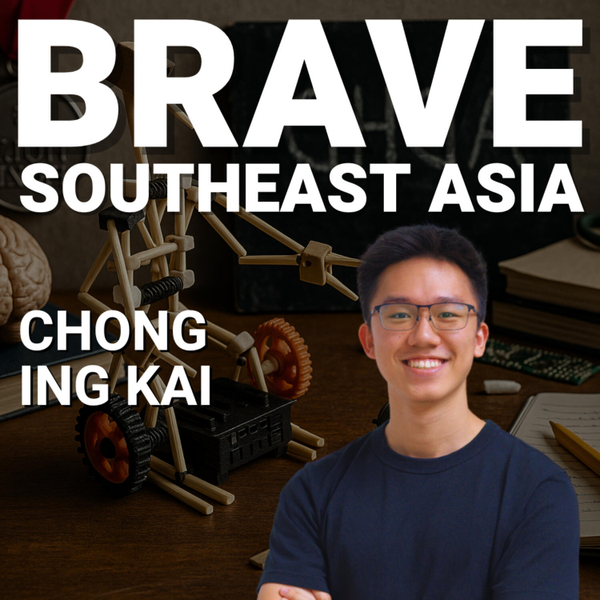

"Screen time is inevitable because many digital materials have real learning value, and I see Stick'Em as a way for kids to step away from screens. Kids used to go to the playground or void deck to play, but now they choose online games like Fortnite with friends. If we show them that building is fun, robots are fun, and hands-on learning is fun, we can shift them away from being fully digital." - Chong Ing Kai, Founder and CEO of Stick’Em" - Chong Ing Kai
"We were fresh out of secondary school with useful skills and decided to solve the problem ourselves, so I gathered my friends and we sketched an idea to make something like LEGO robotics but ten times cheaper. It would help kids be more creative than simply building a fixed LEGO creation, and we wanted to work with schools. Five years ago, we built a prototype within a few weeks using our school’s makerspace, spending about 100 USD of our own money. We tested it with our parents’ friends’ kids, spoke to teachers we knew, and slowly grew the idea through continuous testing." - Chong Ing Kai, Founder and CEO of Stick’Em" - Chong Ing Kai
"Honestly we did not think we were going to win; the Hult Prize was simply a chance to get exposure to great mentors and spend a month in London meeting world-class teams in the social impact space. We planned to refine our pitch, learn as much as possible, and out of 15,000 teams we entered the accelerator with around twenty others, then made it to semifinals, finals, and the final eight, where we realized we might actually have a chance. It became a matter of showing the judges that even though the idea is simple and easy to understand, a million dollars could truly scale our impact." - Chong Ing Kai, Founder and CEO of Stick’Em" - Chong Ing Kai
In this episode, Jeremy Au speaks on chopstick robots, ADHD grit, and why tinkering beats traditional STEAM.
Keywords: Chong Ing Kai, Chopstick Robots, ADHD Grit, Why Tinkering Beats Traditional STEAM, Singapore, Southeast Asia, Education, Founder Story