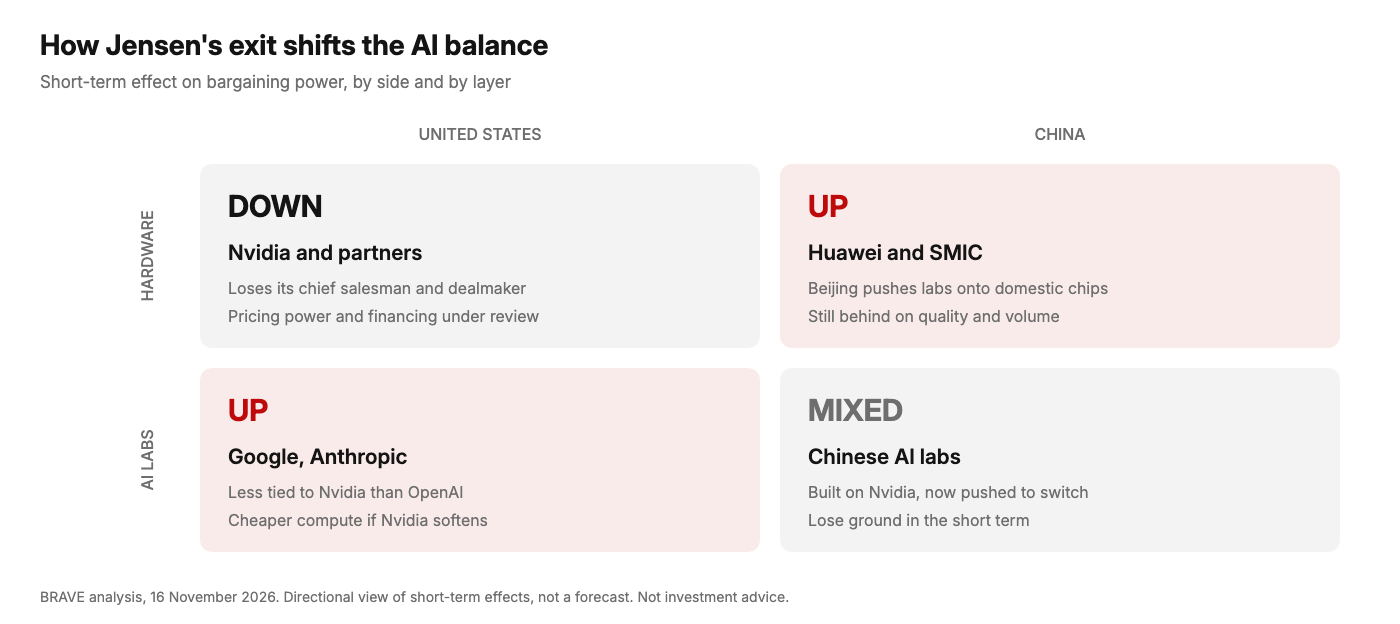
Jensen Huang has resigned as Nvidia's CEO. CFO Colette Kress is interim CEO while the board looks for a successor (Nvidia). Many of the headlines are about his private life. This issue is about something else: what his exit means for Southeast Asia's ecosystem, markets and movers. Below the analysis you will also find summaries of two podcast episodes: Shiyan Koh on why Southeast Asian founders should spend more time in San Francisco, and Adrian Tan on what the Nanning scam teaches us about marketing.
Start with key-man risk. Huang was founder, chief technologist and chief dealmaker, with about 60 direct reports. A petition to bring him back has passed 150,000 signatures (Tom's Hardware). Nvidia has been one of the most pivotal drivers of the AI surge and now we are all trying to figure out what this impact is. Here is our initial draft analysis, which can change over time.
There is no single China
Most coverage treats China as one actor. In this story there are several: the government, its chipmakers such as Huawei and SMIC, its AI labs, and the middlemen who sourced Nvidia chips through third countries. Their interests do not line up.
One example: about 600,000 Nvidia H200 chips are reportedly sitting in Hong Kong, waiting for Beijing's import approval (TechCrunch). Beijing wants its labs on domestic chips, even though Huawei and SMIC cannot yet match Nvidia on quality or volume. For scale: Nvidia was expected to charge about US$27,000 per H200 (SiliconANGLE), which would put the 600,000 chips at roughly US$16 billion. That is our estimate, and the real value in China is likely higher: export controls limit supply while demand stays strong, so chips there trade at a steep premium (Sovereign Magazine).