This week, two of Southeast Asia's largest platforms deepened their bets on AI. On 14 October, Grab and OpenAI launched a program to train 3,000 drivers, sellers and partners in Thailand, each with three months of free ChatGPT Plus (CNN). A day later, Sea Labs, the technology arm of Shopee, Garena and Monee, partnered with Google's AI Futures Fund for access to Google's frontier models and engineers (e27). Grab first teamed up with OpenAI in 2024 (Grab).
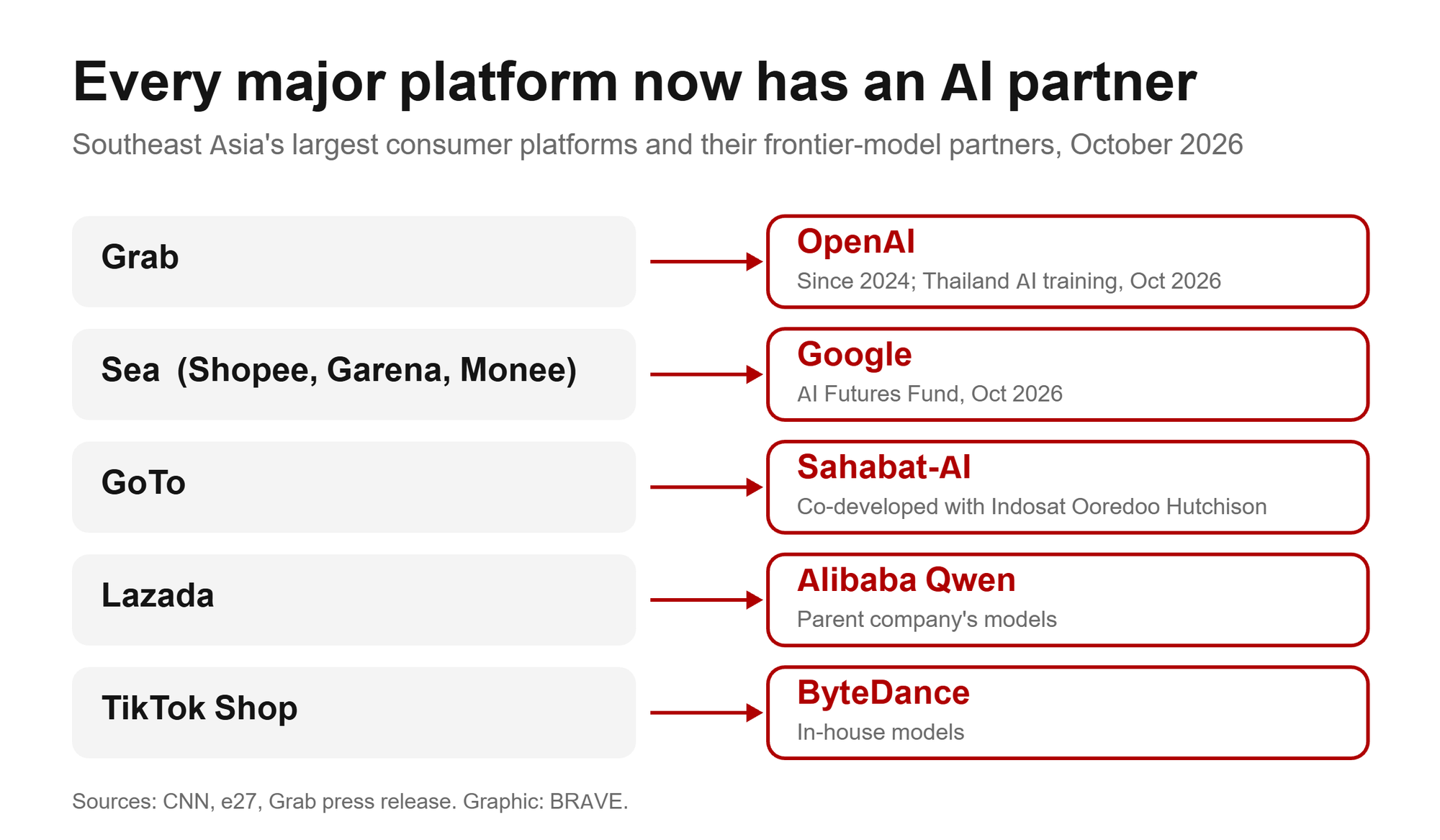
When every major platform in the region has a model partner, the model stops being the advantage. A resource that becomes widely available loses its value to whatever stays in short supply. For founders and operators in Southeast Asia, the practical question is: if everyone can use the same AI, what is still scarce?
Our recent guests gave three answers.
1. Data, distribution and brand
At the Crosscurrents Summit panel on enterprise AI moderated by Jeremy Au, John Homer Alvero, who leads AI engineering at Converge ICT in the Philippines, said that with the same frontier models available to every company, what differs is your own data and how well you coordinate your AI tools. Aravind Kandiah, co-founder and CTO of Bifrost, pointed to everything built around the model, especially brand. Jun Wakabayashi of AppWorks said distribution matters most, because it is the one thing the AI labs lack.
"It's everything but the model. Everything else is a harness." - Aravind Kandiah, Bifrost
e27's analysis of the Sea deal points the same way. It argues that models are becoming interchangeable, and that Google gets a live testing ground of hundreds of millions of users across Southeast Asia and Latin America (e27). For the AI labs, these partnerships are also a route into the region's daily habits.