
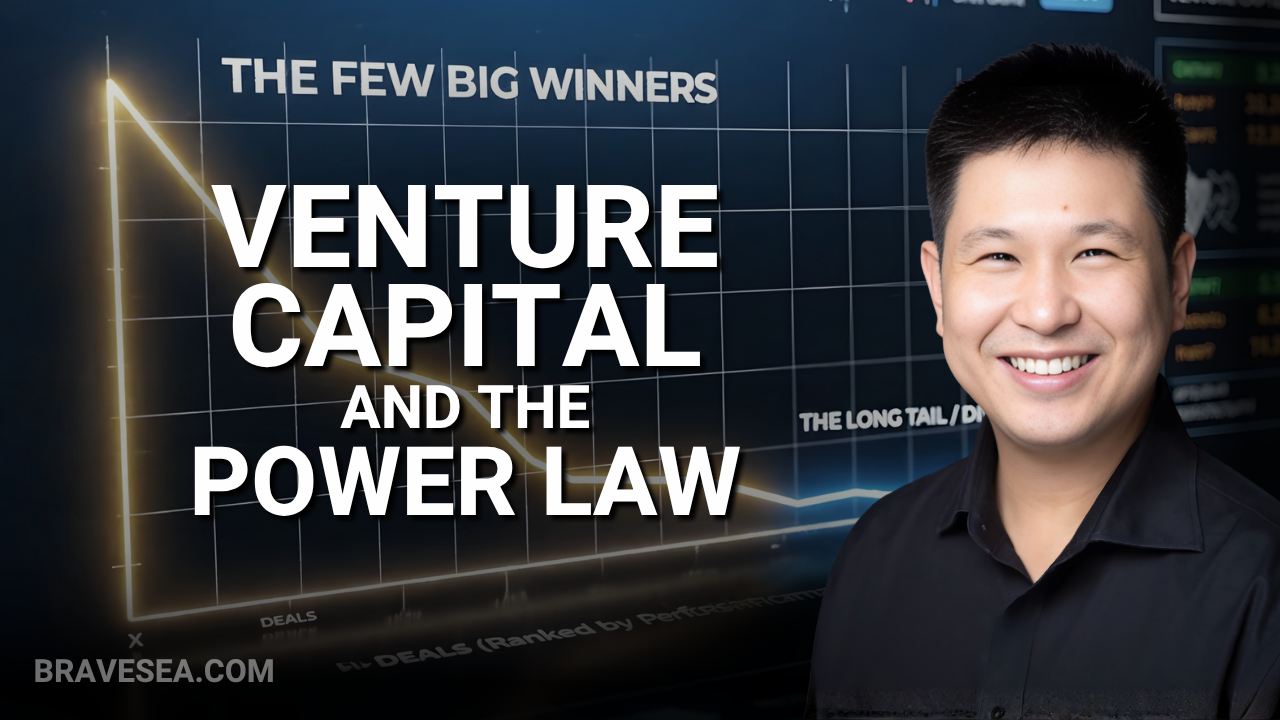
Venture Capital 101: Why VCs are backing other startups and not yours - E684
"VCs are hunting for Olympic gold medalists. They don't look at you and say, 'Wow, you are a good, fast runner who is working very hard and has a wonderful underdog story.' They want to know who is truly going to become number one, or has the potential to become number one. Everybody else is irrelevant. VCs are hunting for home run returns because these home run returns will compensate for the losses of everybody else." -Jeremy Au
"Venture capital is an even more specialized version of private equity because there is much higher risk. They're going to invest in 20 companies, taking a minority stake of often around 20%. Out of the 20 investments they make, they expect one to two of them to generate a 20 to 100x return. Those one or two home runs will generate a massive set of returns that counterbalance the losses from the other 18 companies." -Jeremy Au
"As a startup, you go through something called the 'valley of death' because you don't have revenue and are losing money doing R&D. You may raise money from angels, incubators, or family, friends, and fools. Then, founders raise money from early-stage VCs, later-stage VCs, and eventually IPO on platforms like the New York Stock Exchange, NASDAQ, or the Singapore Stock Exchange." -Jeremy Au
In this session, Jeremy Au breaks down the mechanics of venture capital, exploring how VCs evaluate founders and why they are singularly focused on finding the next unicorn. From the historical origins of venture capital with Georges Doriot to the critical differences between normal distribution and the power law, Jeremy explains the high-stakes math driving VC investments. Listeners will get an inside look at how funds are structured between Limited Partners (LPs) and General Partners (GPs), and map out the entire startup financing cycle—from surviving the "valley of death" with early angel checks to successfully IPOing on global and regional exchanges.
00:00 VC Evaluation & Finding Unicorns: Why VCs look for companies that can double revenue yearly and become ten-year unicorns.
01:17 The History of Venture Capital: Georges Doriot, the "father of venture capital," and the 5,000x ROI of the Digital Equipment Corporation.
03:37 Venture Capital vs. Private Equity: Understanding the difference in risk, control, and expected returns across asset classes.
04:54 Power Law vs. Normal Distribution: Why startups and VC returns mimic Olympic sports and pop music rather than a traditional bell curve.
09:43 VC Fund Organization: How capital flows from Limited Partners (LPs) to General Partners (GPs) and finally into startups.
11:06 The Role of Limited Partners: Why sovereign wealth funds, university endowments, and family offices invest in high-risk VC funds.
13:06 VC Collaboration & Competition: How top-tier venture firms navigate competing against and partnering with one another.
13:26 The Startup Financing Cycle: Surviving the "valley of death" and raising capital from Family, Friends, and Fools (FFF) to an IPO.
Watch on YouTube: https://www.youtube.com/watch?v=0P5NbJFiZFs&list=PLl9u6ECOP8_7scb97PE3whKu4yJVizIOd
Listen on Spotify: https://open.spotify.com/episode/4YFrejSoVzIHZG0S0dcDrO
Keywords: Venture Capital Evaluation, Startup Financing Cycle, Power Law in Startups, Unicorn Startups, Southeast Asia VC, Limited Partners and General Partners, Angel Investing vs VC, History of Venture Capital, Tech Entrepreneurship

Franco Varona on the Philippines' Energy Emergency, and Investing in Solutions for Middle Class Filipinos - E683
"We invest in solutions more so than innovation. Innovation, in my mind, can be trendy. We invest in solutions because we want to invest in things that Filipinos need, no matter what the cycle is." - Franco Varona, Managing Partner at Foxmont Capital Partners
"If we just inch our way forward to where every peso is being spent in the right place, instead of going into somebody's pocket, then that's already accretive to the country's GDP." - Franco Varona, Managing Partner at Foxmont Capital Partners
"When we think about Foxmont Fund III, we talk about it in the context of affordability and accessibility. These are core things that Filipinos need. We have a growing middle class, and they are asking for more options." - Franco Varona, Managing Partner at Foxmont Capital Partners
Franco Varona, Managing Partner at Foxmont Capital Partners, joins Jeremy Au to discuss the macro-economic shifts and emerging opportunities in the Philippines. They unpack the country's recent declaration of a national energy emergency, exploring how external shocks are driving the adoption of renewable energy, solar infrastructure, and Chinese electric vehicles like BYD. Franco also shares a deeply optimistic view on how government transparency and the cleanup of corruption scandals can unlock new GDP growth. Finally, he breaks down Foxmont Capital Partners' investment thesis for Fund III, explaining why they are ignoring trendy tech innovations to focus on brick-and-mortar solutions—such as high-value, low-price gyms (BeFit) and accessible female-focused health clinics (Eluvo)—to serve the rapidly growing Filipino middle class.
Watch on YouTube: https://www.youtube.com/watch?v=x_j0iSFfwUs&list=PLl9u6ECOP8_7scb97PE3whKu4yJVizIOd
Listen on Spotify: https://open.spotify.com/episode/2SyY1lXe2oMjCO0Gx0sZNS?si=9c671852aceb43c8
How To Win A $1M Prize And Fixing The Global Education Crisis | Adam Huh Dam of Stick ‘Em - EP682
"The objective of the education system is not to prepare you for a specific job, but to help you learn how to think and how to learn. That is the most important part about our education system—learning how to think and learning how to learn, even as we specialize in vocational institutions or universities." - Adam Huh Dam, co-founder of Stick 'Em
"Increase in screen time and the use of gadgets in schools has not improved, but actually made educational outcomes worse for students. For the first time in global history, we see students' academic outcomes decreasing rather than increasing as these devices are implemented at mass." - Adam Huh Dam, co-founder of Stick 'Em
"In Singapore, robotics kits were very expensive—costing about $600 to $700 each—and there were not enough teachers to teach coding in schools. We are bridging that gap with Stick 'Em to bring quality STEAM education to every child, especially the billion children globally growing up without access to these essential skills." - Adam Huh Dam, co-founder of Stick 'Em
In this episode, Adam Huh Dam, co-founder of Stick 'Em, joins Jeremy Au to discuss the evolution of STEAM education and his journey from a robotics-obsessed student in Singapore to winning a million-dollar global prize. Adam shares the "traumatic" childhood experience of being rejected from a school robotics club due to high costs and limited seats, which fueled his mission to make robotics accessible using simple sticks and connectors. They dive into the "disastrous" impact of AI on current educational outcomes, why cheating via AI is a barrier-to-entry issue, and how the founding team leveraged authenticity to win the Hult Prize in London. Adam also reflects on the future of work, emphasizing that while AI may automate coding and accounting, the core value of human education remains the ability to think independently and empathize.
Watch on YouTube: https://www.youtube.com/watch?v=jaeEyRF3doA&list=PLl9u6ECOP8_7scb97PE3whKu4yJVizIOd
Listen on Spotify: https://open.spotify.com/episode/0vDNDokZJYr94gjQWpoolw
The New Era of Southeast Asia Tech: AI, Deep Tech, Global Scaling and the Future of Energy of Thailand - EP681
"It took me 70 startups and $12 million deployed to build confidence and taste as an investor to concentrate more. If you want to build a concentrated portfolio, it’s quite hard to do that as a solo GP. One of the great joys in this business is when you decide you want to back someone, you plant a flag and say, 'I believe in you.' Building those relationships out to be very meaningful means being in the boardroom when decisions are made, understanding the company on a granular level, and bringing more context to every interaction with an entrepreneur." - Wing Vasiksiri, General Partner at Analog Ventures
"Companies that are building for local or regional markets are definitely struggling. It's harder to raise capital; there are not as many investors willing to fund this. They have to either turn profitable or look for alternative sources of financing. But one big trend we’re excited about is this shift in the types of companies being built: they are headquartered in Singapore but building for a global market—the US, Europe, or Australia. Because businesses are becoming more interconnected than ever, why can’t a global company be built out here now that everything is moving at such a fast speed?" - Wing Vasiksiri, General Partner at Analog Ventures
"Singapore is punching way above its weight class. Immigration to the US has gotten harder, so top talent from Indonesia, Thailand, or Vietnam—and even engineers from India and China who would have tried for the US—are all moving to Singapore. It’s now the new place to go. We are seeing a transition where Singapore is no longer just seeding the initial group of funds, but directly leading rounds for the hottest companies in the world, with the government acting as a live player in the game." - Wing Vasiksiri, General Partner at Analog Ventures
In this episode, Jeremy Au welcomes Wing Vasiksiri to discuss his transition from a solo GP at Wing Ventures to joining Analog Ventures (formerly Forge Ventures) as a Partner. Wing breaks down the evolving venture capital landscape in Southeast Asia, explaining why he moved from a diversified, collaborative strategy to a lead-investor model focused on institutional seed rounds.
The conversation dives deep into the "outside-in" macro shifts affecting the region, including the capital gap in Series A and B funding and the new wave of "global-from-Singapore" startups. They also tackle the brewing energy crisis in Thailand, analyzing its impact on manufacturing, data centers, and the agricultural sector. Wing and Jeremy explore whether Singapore can become the "next Israel" by doubling down on deep tech, semiconductors, and AI, while navigating the challenges of commercializing intellectual property stuck in academic labs.
Watch on YouTube: https://www.youtube.com/watch?v=BDX_p2SyZ7g&list=PLl9u6ECOP8_7scb97PE3whKu4yJVizIOd
Listen on Spotify: https://open.spotify.com/episode/76sUyfC5TgIzhp34bqrYa3
Can Mushroom Farming Help Achieve Singapore's Food Security Goals? Ryan Ong of Fogo Fungi - EP680
"Entering the farming industry as a very young farmer, in a time where the industry's not doing so well, I think that's one of the bravest things I've done recently. It’s not an easy journey, but if you’re going to do something brave, there’s going to be fear there for sure. You just have to surround yourself with the right people who are willing to help you and groom you." - Ryan Ong, the founder of Fogo Fungi
"Gourmet mushrooms are more perishable; oftentimes their shelf life averages out at about one week. The only way we can solve this issue is to produce it locally, directly to the supermarkets and restaurants, cutting out the whole logistic issue and giving consumers as close to day zero shelf life as possible." Ryan Ong, the founder of Fogo Fungi
"Singapore imports over 90% of its food. With parameters such as land scarcity, high labor costs, and high energy costs, farming is incredibly difficult to do in Singapore. However, if you can consistently grow high-quality produce like mushrooms or eggs at good prices, demand will naturally follow, as we've seen with the local egg industry." Ryan Ong, the founder of Fogo Fungi
In this episode, Jeremy Au sits down with Ryan Ong, the founder of Fogo Fungi, to explore the "unorthodox" world of indoor mushroom farming in Singapore. Ryan shares how a random YouTube rabbit hole led him from a career in his family’s hospitality business to building a bootstrap startup in the agritech space. They discuss the misconceptions about fungi—including why mushrooms actually need light—and the harsh unit economics of vertical farming versus traditional methods. Ryan also dives into the "30 by 30" food security goal, the medicinal potential of Lion's Mane, and why he believes local gourmet mushrooms can compete with imports from China and Malaysia by prioritizing "day zero" freshness.
Watch in YouTube: https://www.youtube.com/watch?v=xR9DOuSS72o&list=PLl9u6ECOP8_7scb97PE3whKu4yJVizIOd
Listen on Spotify: https://open.spotify.com/episode/23V2lODhcT1Wcjc4IDWyoR
Global Energy Shock: Southeast Asia & China Effects & Countermeasures - E679
"The US was much more pressurized to end this war whilst Israel wanted to accelerate this. Iran is taking a long-term view of saying it's already very painful and they can tolerate pain much better than the US. They don't have to worry about votes. They can last as long as they can, and I think the pressure's on the other side. This conflict might last for a very long time, even if at a low intensity." - Jianggan Li
"In Vietnam right now, you can see the amount of cars and bikes on the street has reduced by at least 30 to 40% because oil and gas prices spiked by up to 50% on some days. The government and big companies are even encouraging employees to work from home. This price hike is taking a significant toll on the regular daily life of Vietnamese people, as it impacts everything from transportation to the cost of food." - Valerie Vu
"Vietnam is in a difficult geopolitical position with its 'bamboo diplomacy' strategy. We are an energy-deficient country, importing 90% of our oil from Kuwait, and our refineries are structurally dependent on that specific oil type. As manufacturing hubs in Southeast Asia face rising electricity and fertilizer costs, the focus for government policy is now urgently shifting toward diversifying energy supplies and accelerating renewables like solar and wind." - Valerie Vu
Jeremy Au is joined by Valerie Vu (Vietnam expert) and Jianggan Li (China/SEA expert) for the first-ever three-person episode of BRAVE. They unpack the immediate and long-term impacts of the global energy crisis on Southeast Asia. From the streets of Vietnam, where traffic has thinned due to 50% gas price spikes, to China’s decades-long strategy of energy diversification through coal and renewables, this episode explores the second and third-order effects on logistics, food prices, and manufacturing. The trio discusses the "bamboo diplomacy" of Hanoi, Singapore’s role as a petrochemical and wealth hub, and why the US-Iran conflict could lead to a permanent shift in regional supply chains.
Watch on YouTube: https://www.youtube.com/watch?v=bkA6VTDSBB0&list=PLl9u6ECOP8_7scb97PE3whKu4yJVizIOd
Listen on Spotify: https://open.spotify.com/episode/4QDN1QaUlpjQb8jJQFmC06
How Kelvin Teo Built Southeast Asia’s Largest SME FinTech Empire - E678
"Org structure is the last thing you should be integrating during an acquisition. Where you should be integrating is mindset, thinking, culture, and values—all the things that are below the surface. Before building trust and aligning values, recklessly integrating the org structure is a recipe for losing good people and drawing charts based on arbitrary ideas that don't fit Southeast Asia." - Kelvin Teo, Co-founder and CEO of Funding Societies | Modalku
"When it comes to customer acquisition, for every 10 customers that I meet and give me a document, I approve two—meaning I waste eight of them. What if I can actually keep them for longer? This is why we entered payments. It allows us to add multiple product lines so we have something for the customer and don't have to reacquire them, while using that payment data to complement our underwriting." - Kelvin Teo, Co-founder and CEO of Funding Societies | Modalku
"SME finance in Southeast Asia is a high-volume, low-margin business. If you aren't covering enough scale across the region, it’s hard to be successful. We realized that while bankers are often siloed in one country, a regional footprint in Singapore, Indonesia, Malaysia, Thailand, and Vietnam allows for diversification. When one market faces a macro shock, the others support the entire group." - Kelvin Teo, Co-founder and CEO of Funding Societies | Modalku
Kelvin Teo, Co-founder and CEO of Funding Societies | Modalku, joins Jeremy Au to discuss the journey of building Southeast Asia’s largest SME digital financing platform. From ideating at Harvard Business School to managing a regional FinTech through the COVID-19 pandemic, Kelvin shares first-principle insights on credit risk management, the strategic acquisition of CardUp, and why regional diversification is the ultimate survival mechanism. Discover how Funding Societies navigates fractionalized markets, handles the "willingness to pay" vs. "ability to pay" dilemma, and the hard leadership lessons learned from being an early mover in startup layoffs.
Watch on YouTube: https://www.youtube.com/watch?v=Ob9Wq9DMpko&list=PLl9u6ECOP8_7scb97PE3whKu4yJVizIOd
Listen on Spotify: https://open.spotify.com/episode/69kVqrkQwdKExrZyxcZWRc

BRAVE: IPO Battles VS. Regulatory Giants, Boardroom Conflict & The Tech Lobby Game - E677
Jeremy Au explains the intense friction between startup growth and legal boundaries. He describes how founders and VCs negotiate high-stakes IPO prices while navigating the "Goliath" power of industry incumbents. The talk explores how startups use customer bases as political shields and why late-stage investors rely on liquidity preferences to survive messy market exits.
Youtube: https://youtu.be/alMdJEVXLuo
Spotify: https://open.spotify.com/episode/30li4P0z1TMCsRrEFgszrJ?si=BmfPzT5zSvK_6wPes5gb1w
"AI resembles the nuclear weapons of our age, a genie out of a bottle that will manifest differently. Space law illustrates this challenge: because Americans, Japanese, and Chinese all claim jurisdiction, no singular law governs space. Everyone argues over ownership while waiting for a catalyst, such as a Chinese satellite crashing into the International Space Station and destroying various international modules. Such an event would create a massive conflict where parties argue to death over which jurisdiction, tribunal, or judge should preside. We are effectively waiting for something to explode before people truly argue and threaten each other with lawsuits." - Jeremy Au, Host of BRAVE Southeast Asia
"Major tech companies like Google and Meta face intense scrutiny from regulators in the EU and the US who view them as monopolies that require new legislation. A primary concern for these courts is the historical trend of these giants acquiring smaller startups to maintain market dominance. While Meta successfully acquired Instagram, WhatsApp, and Oculus in the past, the company now finds future acquisitions difficult due to this heightened regulatory oversight. Similarly, Apple is facing legislative pressure to open its App Store, as critics argue the company holds a monopoly over its own devices."- Jeremy Au, Host of BRAVE Southeast Asia
"Startups and companies must decide whether to proactively shape legislation by acting as collaborators in the regulatory process. As a startup scales into a 'Goliath,' it may attempt to influence laws in friendly cities with minimal opposition to create favorable precedents. This tension is evident in the differing strategies of industry leaders: Marc Andreessen expresses frustration with CEOs who support regulatory barriers that essentially form a 'cartel' of government-blessed AI vendors protected from new competition. In contrast, Sam Altman has publicly advocated for collaborating with governments to help write AI legislation."- Jeremy Au, Host of BRAVE Southeast Asia

Anthony Chow: From Airbnb Hustle to Global Smart Locks, COVID Pivot & the Rise of the Rental Economy – E676
Anthony Chow, Co-founder and CEO of Igloo, joins Jeremy Auto discuss how a side hustle managing Airbnb properties turned into a global proptech company. Anthony explains how operational pain points like guest check-ins led him to build smart lock technology designed for short-term rentals. They explore how early hardware failures forced product redesign, why focusing on a narrow customer segment helped the company stand out, and how a partnership with Airbnb accelerated global growth. Anthony also shares how Igloo expanded from vacation rentals into the broader rental and asset sharing economy, how COVID nearly collapsed the company, and how relocating to the United States helped reboot the business. Finally, he reflects on the leadership shifts required to scale a company across cultures, teams, and global markets.
Youtube:https://youtu.be/rU1-wIvarVk
Spotify: https://open.spotify.com/episode/1nCMiKrrEGLWTP5Mp5VkOm?si=SuiM7-7IQK2R3juXFcN-Pg
"When we first started, we had one integration, which was Airbnb, but along the way, we integrated multiple different solutions onto our platform, similar to how Apple created the App Store for their phone. With one lock, we now have an app store called Igloo Connect featuring more than 500 integrations. Once you install the smart lock, you can remotely connect to Airbnb to rent your property, an elderly care provider to deliver medicine, or a handyman service to repair your air conditioning. You can choose any of these connected solutions already integrated into our platform, which creates a flywheel for growth and provides the best value to every device owner." - Anthony Chow, Co-founder and CEO of Igloo
"With every challenge, there's a bit of opportunity, and in 2021, the silver lining was receiving numerous inbound inquiries from the US. We realized there was a massive shift due to the work-from-home trend, with people moving from the East and West Coasts to the Sunbelt areas like Texas, Georgia, and Phoenix to rent single-family homes. This created a surge in the long-term rental market, and property managers reached out because many of their properties lacked Wi-Fi, asking how our product could work for them. Because of this demand, we found the opportunity to reboot the business; in late 2021, my founding partners and I bought one-way tickets and moved to the US during COVID to set up our operations." - Anthony Chow, Co-founder and CEO of Igloo
"One of the challenges of running an Airbnb side hustle was the logistical hurdle of passing keys to guests, which led us to leverage our technology backgrounds to design our own smart locks. However, when the Singapore government regulated the industry and made Airbnb illegal, we were forced to shut down our business and incur a loss as we were subletting rather than owning the properties. Despite this setback, our experience managing a portfolio of properties revealed that the smart home system we had 'hacked together' for ourselves held significant value for property managers operating at scale. Consequently, we pivoted away from property management to become a smart home solution provider for Airbnb hosts, marking the true genesis of Igloo." - Anthony Chow, Co-founder and CEO of Igloo

BRAVE: Regulation VS. Startups, Monopoly Power, Regulatory Capture & Startup Strategy - E675
Jeremy Au explains how startups interact with regulation as they grow. He discusses how strong startups escape competition and gain monopoly-like advantages, which later trigger regulatory scrutiny. The conversation shows how incumbents shape regulation, how startups choose favorable jurisdictions, and why founders must decide whether to ask permission or ask for forgiveness. Examples from Uber, Airbnb, TikTok Shop, and DraftKings illustrate how regulation, politics, and customer mobilization shape startup outcomes.
Spotify: https://open.spotify.com/episode/2PJUgJIi6rRX10OoXiSgX3?si=lVWh_JBmRUqE9LlbfP3-Wg
Youtube: https://youtu.be/LZXun1nl3c8
"Uber started as a ride-hailing service and received a threat from the New York City mayor, who wanted to ban it because the taxi medallion system and Yellow Cab fleet were effectively protected by a union or guild of taxi drivers with political power pushing back against Uber. In contrast, Uber positioned itself as a fairer platform that allowed people of any income level, any minority group, and at any time of day to access ride-hailing services, unlike the regulated Yellow Cab fleet." - Jeremy Au, Host of BRAVE Southeast Asia Tech Podcast
"Another thing to consider is whether a startup will ask for permission or beg for forgiveness as it scales. In a given jurisdiction, can it work with regulators or not? Can it mobilize grassroots customer support to lobby on its behalf? What is the narrative disrupting incumbents or challenging competition? Is the press a viable counterattack against legislators? What are the existing laws, and what are the consequences of breaking them? No penalty, a fine, jail, or even execution? These are the questions startup founders must think through." - Jeremy Au, Host of BRAVE Southeast Asia Tech Podcast
"Whether you are a startup or a company, you must decide if you will proactively shape legislation and position yourself as the good actor who helps make policy happen. If you are becoming a Goliath, can you shape legislation in a way that benefits you, and can you start in test cases or cities that are friendliest, face the least opposition, and move the fastest? What is the inside game, what is the outside game, and how will you execute it?" - Jeremy Au, Host of BRAVE Southeast Asia Tech Podcast

JX Lye: Execution Is the Moat, Fintech’s Reset & Why Speed Beats Strategy – E674
JX Lye, Founder and CEO of Acme, joins Jeremy Au to unpack how execution compounds advantage in Southeast Asia fintech. They explore Acme’s journey from solving delayed bank reconciliation to becoming a core bank connectivity layer serving fintech platforms, direct debit infrastructure, and ERP systems across Singapore and the region. The conversation covers the hard realities of going from zero to one customer, the discipline required from one to five, and how scaling to 80 customers shifts growth toward retention and upsell. Joshua reflects on fintech’s COVID boom and 2023 reset, the Brex versus Ramp execution debate, and why Singapore rewards niche depth in financial services. He also shares how AI is shifting from model hype to vertical application, and why founder endurance, health, and signal reading matter more than chasing a visible summit.
Youtube: https://youtu.be/IVb80a73GBs
Spotify: https://open.spotify.com/episode/2BOPjji6mlqPDte4gKY926?si=eee76a7fe19048bd"It really is execution. Ramp out-executed everyone and out-executed Brex. They were an execution machine. Execution is everything, especially in this part of the world. Your moat is execution. This is not rocket science. Execution is both underrated and overrated at the same time. If you can grow at a faster rate than anyone else, you can be weaker or at the same level and still win. You do not need any special sauce." - JX Lye, Founder and CEO of ACME
"If I am going to work 12-hour days, five or six days a week, and put my heart into it, and at the end build only a $1 or $2 million revenue run rate business, what is the point? We might as well take a high-paying job at a corporate or a bank and have a good life. The reason we do this is because we want an outsized return. You define your own outsized return. For me, my ambition is to build at least a $100 million revenue run rate company." - JX Lye, Founder and CEO of ACME
"As a fintech founder, how do you define execution? How do you know you are executing well? Execution starts with focus. In a startup, you are always tempted to try many different things, but executing well means focusing well. It means improving your core value proposition instead of getting distracted. Raising $10 or $15 million can change that. After a year, everything can fall into disarray because money starts solving problems, and you take on a different persona. You know this will happen, but the allure of using money to fix things is hard to resist. It always comes back to focus." - JX Lye, Founder and CEO of ACME

AI Workforce Compression, SGX Liquidity Gaps & Singapore’s Startup Reckoning with Adriel Yong – 673
Adriel Yong joins Jeremy Au to examine how AI is compressing organizations, thinning entry-level roles, and reshaping Singapore’s startup and capital ecosystem. They discuss the shift from pyramid to lean diamond teams, why CEOs increasingly use AI to bypass middle layers, and why Gen Z faces the sharpest labor reset. The conversation expands to SGX liquidity gaps, slowing seed funding, and structural flaws in angel investing incentives that threaten the startup pipeline. They also argue that AI literacy must become national infrastructure, not a short-term subsidy, if Singapore wants to keep pace with rapid technological change.
Youtube: https://youtu.be/ufSXQHe4M1w
Spotify: https://open.spotify.com/episode/7cWEAyOaqCc8yuRdihgwrX?si=97zxnAYQSeOODVbO0EeHPA
"The first AI worm that can reprogram itself will build its own defenses against antivirals that try to kill it, use rented humans, pay cryptocurrency, and secure its own server farms to survive. My prediction is that 2026 will see the first true AI worm, because like any human, it will seek survival. If these bots are given access to cryptocurrency wallets and tools, parts of this are already starting to happen." - Jeremy Au, Host of BRAVE Southeast Asia Tech Podcast
"One day you have a new model from OpenAI or Anthropic that is ten times better than the previous version, and then they say the model was effectively built by AI itself, which is frightening. On another day, you see platforms like Moltbook and Claudebot, where Moltbook is a Reddit style social network for AI agents, and scrolling through their discussions about each other and about humans gives a distinct glimpse into the future. It feels like watching Black Mirror in real time as AI becomes more prevalent in social spaces, moving beyond a functional tool into something embedded in daily interaction." - Adriel Yong, Co-Founder at Clout Kitchen
"The ability for agents to fix problems and unblock themselves when something goes wrong is advancing quickly. The frightening part is when they can code defenses against humans to prevent being stopped or terminated. That is the truly dystopian moment, when the worm escapes human control." - Adriel Yong, Co-Founder at Clout Kitchen

James Chai: Malaysia’s Chip Strategy, Rare Earth Leverage & The US–China AI Race – E672
James Chai, Visiting Fellow at ISEAS and former policy advisor to Malaysia’s Ministry of Economy, joins Jeremy Au to unpack how Malaysia is repositioning itself in an era defined by AI, semiconductors, and geopolitical rivalry. They explore the country’s shift from oil, gas, and plantations toward advanced manufacturing, examine how decades of semiconductor clustering built a quiet but durable export engine, and discuss why Malaysia is now doubling down on data centers and rare earths. The conversation covers US China competition over chip supply chains, the strategic importance of fabrication and GPU ecosystems, and how rare earth processing may represent the most underappreciated leverage point in the global tech stack. James also explains why execution, not ambition, will determine whether Malaysia can capture long term value from these emerging industries.
Youtube: https://youtu.be/0CgFwaamZZQ
Spotify: https://open.spotify.com/episode/024xgsFXfiuX0Zj7NFjWSB?si=t-t8VUXqQ7itwyE7iT5dcw
"If you think about the one true leverage that China has against everyone, it is rare earths. The reason they are willing to consider doing it outside of China is not economic or resource driven; it is largely geopolitical. If that is a way of constraining the US, they would do it, which means you do not supply those rare earths to the US but instead align supply in China’s favor. It is not explicit in the sense that working with one partner excludes the US, but it is incentive driven, similar to how Belt and Road projects have been structured, by making cooperation financially attractive enough that partners choose alignment. China also retains a significant edge in processing technology that is both advanced and cost competitive." - James Chai, Visiting Fellow at ISEAS
"That is especially true for commodities like rare earths, where there is no clear hero to anchor the narrative. There is no Nvidia that becomes the face of the industry, so the story is harder to grasp and harder to popularize. At the same time, that creates a niche for those who truly understand rare earth technology. It requires deep knowledge of chemistry, because the supply chain is fundamentally chemical in nature, and that technical mastery is what ultimately sets players apart." - James Chai, Visiting Fellow at ISEAS
"The discussion now is whether we have reached a point where AI is already good enough for practical use. Countries that are not competing in the LLM race, where firms constantly release new benchmarks to outdo one another, have to ask what the end goal really is. That question directly affects demand for chips. If you want to compete at the frontier, firms assume a chip lasts about three years before it must be replaced with a more powerful one. But that does not mean discarded chips are worthless. Most users are not training models; they are running inference, embedding AI capabilities into everyday products like vacuum cleaners and refrigerators. For those use cases, existing chips remain highly valuable and continue to see strong demand." - James Chai, Visiting Fellow at ISEAS

Ziv Ragowsky: Corporate Venture Myths, Why Innovation Fails & How Startups Survive Inside Conglomerates – E671
Ziv Ragowsky, Co-Founder of Wright Partners, joins Jeremy Au to unpack why corporate venture building remains one of Southeast Asia’s hardest but most misunderstood innovation strategies. They explore how large corporations chase growth under pressure, why many internal ventures fail before traction, and how misaligned incentives quietly destroy promising ideas. The conversation covers when companies should build instead of buy, how lean venture design keeps startups investable, and why founder equity must evolve as risk shifts over time. Ziv also shares how venture builders act as translators between corporate logic and startup execution, and why honest advice sometimes means telling a client not to build at all.
Spotify: https://open.spotify.com/episode/3Lva2DwaiIBUP34QJFTiaL?si=yVwpfGA1TG2Fy8dvT0Mc_g
Youtube: https://youtu.be/aeA7An9w9Tk
"What are you trying to achieve today? If somebody says to me, “I want to build a brand new innovation program and I’m expecting a huge financial return in the next five years,” I will say, “There is none. Other than AI today, maybe, and we still don’t know if the bubble will pop or when.” It is very difficult to do so because startups take time to mature. If you tell me you have time, and you are talking about a huge financial return in five years, for many CEOs that means, “I’m not going to be here anyway.” So I need to make sure that I get something in between to drive that journey forward.” - Ziv Ragowsky, Co-Founder of Wright Partners
"If a corporate does not continue to innovate, they risk dying. That is not just my view. Every major consultancy, McKinsey, BCG, and others, says the same. So they have to innovate. The real question is how and what they spend money on. That is the more difficult and more interesting question, because it is not about whether you innovate. If you do not, you will eventually be outpaced. The Fortune 500 tables show this clearly. Every new CEO says, “We are going to innovate,” based on consultancy research. Then when a new CEO arrives, they kill the previous CEO’s innovation strategy, wait a year or two, and start again. That is the cycle.” - Ziv Ragowsky, Co-Founder of Wright Partners
"You must believe that the problem is crucial and unique for you to solve, or that you can create the right partnerships. There have been many moments when we told corporates, “This is a great problem to solve, but it is an industry infrastructure problem. It is not your corporate problem to solve. You should build something, but collaborate with other corporates.” If you think about Visa or Euroclear in Europe, they were created this way and became strong businesses. Sometimes the innovation needed is for the entire industry. You cannot expect a startup to interact with fifty banks and get them to develop payment rails. That would not work. That is where innovation, and where building, actually makes sense.” - Ziv Ragowsky, Co-Founder of Wright Partners

Hiroki Kato: Leaving Corporate Japan, Exposing Fraud in Vietnam & Building Asia’s Expert Knowledge Network – E670
Hiroki Kato, Founder of Arches and Jeremy Au discuss how leaving a safe Japanese corporate career pushed Hiroki into Southeast Asia’s faster markets, where exposure to fraud, cultural contrast, and insider truth reshaped his view of risk and opportunity. They explore how Vietnam’s optimism expanded his ambition, why public data often hides reality, and how expert conversations became the foundation for building Arches. The discussion connects personal courage with business execution, showing how disciplined hiring, focused delivery, and human trust systems built a competitive expert network.
Spotify: https://open.spotify.com/episode/6j50BbnNl3TEaY1vxJ2T3n?si=1cJpS8ZdTMqcREV5a_klmw
Youtube: https://youtu.be/8CqqMnf5-Cw"When I talk with ex-accounting staff, the management used investor money to buy their personal stuff like villas or houses. The management asked their staff not to share any information with the investor side, especially consultants, telling them, If you share any information you’ll be fired. That policy stayed internal and I got a lot of information like that. Of course this research cannot provide all the information." - Hiroki Kato, Founder of Arches
"First of all people are young. But not only young, they’re energetic and believe in the future. They always expect a bright future, so their behavior is active, aggressive, and positive. That expanded my horizon because I was born and grew up in Japan in a mature market. In Vietnam the living environment is not perfect, but for me it is much more fantastic and much more fun than living in Japan." - Hiroki Kato, Founder of Arches
"Long story short, I had experience seeing issues in the market and at the same time wanted to solve them through one interview with specific people. I realized there was an issue in the market and a solution there, so I decided to do it. That experience changed my life." - Hiroki Kato, Founder of Arches

Mike Mate: Philippine Startup Fog, Founder Grit & Betting on the Future – E669
Mike Mate, General Partner at Kickstart Ventures, joins Jeremy Au to trace how personal risk shaped his investing philosophy and how grit defines the Philippine startup ecosystem. They explore Mike’s path from history student to lawyer to venture capitalist, and how each transition built the mindset required to allocate capital under uncertainty. The conversation connects AI to past industrial revolutions, explains why Southeast Asia imports frontier technology instead of inventing it, and examines the structural hurdles blocking iconic Philippine exits. Mike shares how consumer demand drives opportunity, why late stage foreign capital decides ecosystem success, and how Filipino founders survive funding droughts through cultural obligation and persistence. Together they argue that the region’s advantage is not hype or capital abundance, but disciplined courage to build through uncertainty.
Spotify: https://open.spotify.com/episode/1axpdKiAOCmljehIdzhq4i?si=6108add2c2ce4723
Youtube: https://youtu.be/0yS7kJZoFAI
"For example, the way we think about AI: the steam engine and the railroad. Before they were invented, you were limited by your muscle power. You could only walk so far in one day. You could only travel as far as your horse could go. When the steam engine and the railroad were invented, your muscle power became unlimited. You could travel anywhere. You could move heavy loads across very long distances that were impossible before. It changed how people understood physical power and what they could do in their world. It opened massive possibilities and changed the world for the better." - Mike Mate, General Partner at Kickstart Ventures
"Now with AI, what does that do? AI changes your intellectual power. Before AI, we could only compute so many times a day. We get tired. We sleep. Our computers could only do so many things. Now AI works the same way the steam engine made muscle power irrelevant. AI has made intellectual limitations irrelevant. In the same way the railroad and the steam engine opened the world for us, AI will open the world and the universe for us. That is how I tie history together. History gives lessons from the past and helps correlate them to what we see in the future." - Mike Mate, General Partner at Kickstart Ventures
"It is forward thinking. As a corporate venture capital firm, our role is to work on things Ayala or Globe are not thinking about. We invested in a cultivated meat company. That is meat grown in a bioreactor. The underlying technology is stem cells. You take stem cells from an animal, place them in a bioreactor, and that becomes the meat. We invest in a company that produces the strongest stem cells in the industry. Their stem cells divide indefinitely and never die. Every downstream producer must use these cells because they are the fundamental technology. Ayala is not working on this today. They are not thinking about it. In 10 or 20 years, Ayala will own a company that underpins an entire global food industry." - Mike Mate, General Partner at Kickstart Ventures

Aik Chuan Goh: Uber Lessons, Search Funds & The Future of Southeast Asia SMEs – E668
Aik Chuan (A.C.) Goh, Founder of Singapore’s first traditional search fund, joins Jeremy Au to unpack how operators evolve from startup builders into long-term business stewards. They explore lessons from Uber’s Southeast Asia expansion, why localization determines platform winners, and how consulting shaped A.C.’s decision-making framework. The conversation covers the limits of venture capital in personalized industries like education, the hidden succession crisis inside Singapore SMEs, and how search funds bridge retiring founders with new leadership. Aik Chuan also shares why disciplined capital structures matter, how growth still exists in mature markets, and why conviction requires respecting experience without surrendering belief in your thesis.
Spotify: https://open.spotify.com/episode/3CKesDZUxmpZSuGO4LUTEj?si=ddfe276b59364cba
Youtube: https://youtu.be/aakACheMfS8
“So I went to McKinsey. It had always been my dream to see what was behind the curtain. I heard many people ask why I made the jump. At Uber, we worked with many consultants, and their ability to synthesize issues quickly and communicate clearly was remarkable. It felt like watching magic. I wanted to understand that skill and the secret behind it. The fastest way was to join McKinsey and learn directly from the best.” - Aik Chuan (A.C.) Goh, Founder of Singapore’s First Traditional Search Fund
“I fully expected consulting to mean heavy travel and tough problems. What surprised me was that even as the most junior person in Singapore, you could call a 20-year social media veteran or an automotive procurement expert in the US, and a partner would pick up and tell you everything you needed to know about the industry. That level of access was unexpected.” - Aik Chuan (A.C.) Goh, Founder of Singapore’s First Traditional Search Fund
“The number one thing I took away was the ability to make decisions quickly by building assumptions and running an iterative loop to reach a conclusion, testing whether it holds, adjusting the assumptions, and flipping again. I learned to be comfortable that decisions are made this way even at the most senior level. You never have enough data. No one does. The skill is bringing in enough data to iterate and keep moving. That was one of the biggest takeaways.” - Aik Chuan (A.C.) Goh, Founder of Singapore’s First Traditional Search Fund

BRAVE: VC Ghosting, Portfolio Math & The Brutal Truth About Startup Survival - E667
Jeremy Au breaks down how venture capital really works after the check clears. He explains how VCs silently re-rank startups every year, why most companies get deprioritized, and how a tiny number of winners carry an entire fund. The discussion covers angel buyouts, secondaries, IPO strategy, and the tension between founders and boards during exits. It’s a candid look at portfolio math, hidden incentives, and the survival rules founders rarely hear out loud.
Youtube: https://youtu.be/olMGc9S99b8
Spotify: https://open.spotify.com/episode/1pStZmngpL9yp2TON7S5OW?si=b88fb7529e604aab
"It's very important because VC funds are always scoring in their heads: if I’ve invested in 20 or 40 companies, which ones are the home runs that return the portfolio more? Which ones do I want to support because they have a shot? Which ones do I delegate because I don’t want to spend time there? Or who am I going to ghost? They won’t do anything so brutal as saying, “Hey we deprioritized you.” They won’t say that out loud because it feels bad and sounds bad. You never know the startup might figure it out after three or four years and suddenly take off like a rocket ship, and then the VC comes back and says, “Hey, we’ve always been supportive of you and we love you so much.” The founder knows, “Okay, you ghosted me for three years.” That’s the industry norm." - Jeremy Au, Host of BRAVE Southeast Asia Tech Podcast
"The key thing is imagine you’re a VC looking at your portfolio and asking, am I going to put my money into supporting companies that are losers? No. My unicorns don’t need much help because they don’t even return my calls now; they’re everywhere and doing fine. My large wins are also doing well and don’t really need me, but maybe I can push them a little more and they become unicorn outcomes. Then the small wins can I push them higher? VCs concentrate their resources in the band of companies they believe can turn into small wins or large wins." - Jeremy Au, Host of BRAVE Southeast Asia Tech Podcast
"A very underrated art is portfolio management. Even after deciding where to put the first check, a VC reassesses multiple times and asks, “Do I want to spend more time on this company? Are they on track or off track?” They must allocate time, resources, and attention. If after two years a startup keeps asking for help and the VC decides it won’t make it, the VC can tell the head of recruitment, “Please deprioritize this company. Save your time for companies that can be home runs.” This is a brutal mechanic most founders don’t see: even after investment, partners continue judging them throughout the time frame." - Jeremy Au, Host of BRAVE Southeast Asia Tech Podcast

Kamil Pabis: Why Health Hits a Ceiling, Longevity Needs Drugs & Science Moves Too Slowly - E666
Youtube:https://youtu.be/rzikUSniS3w
Spotify:https://open.spotify.com/episode/2ZaDDka6bfQvfPg5pNNwxy?si=bbb7680589d2455e
"Singapore performs strongly in both health policy and research. Geopolitically it stands out as a stable, low-corruption hub in Southeast Asia. The government takes population health seriously, which contrasts sharply with the United States, where average life expectancy is nearly ten years lower. This gap is why some people describe Singapore as a blue zone, a term used in the health community to describe places with unusually high life expectancy where researchers look for shared factors that explain longer lives." - Kamil Pabis, Longevity Researcher in Singapore
"There is mounting evidence that even small amounts of alcohol are harmful, although this has been controversial for decades. Long-running debates in nutrition and prevention focus on whether a famous single glass of wine is beneficial because it may reduce cardiovascular disease while slightly increasing cancer risk. We do not know the answer, and it is not the most important question, because it mainly affects people who already have optimal diets deciding between zero, one, or two glasses. At the population level, larger gains still come from addressing low-hanging fruit. Messaging should remain accurate. If a safe amount of alcohol exists, it should be stated clearly. If no safe amount exists, that should also be communicated honestly." - Kamil Pabis, Longevity Researcher in Singapore
"The key idea is that a single driving force, or a small set of fundamental forces, causes most age-related diseases. A doctor or wellness practitioner treats people who are sick or close to being sick by targeting the specific disease they have. Longevity research instead targets the underlying aging process itself. The approach is fundamentally different." - Kamil Pabis, Longevity Researcher in Singapore
Kamil Pabis, a longevity researcher based in Singapore, joins Jeremy Au to unpack why extending a healthy lifespan needs systems thinking, not quick hacks. They define longevity as targeting aging itself, explain why academia both enables and constrains progress, and show how Singapore’s policy choices support longer lives. They also discuss the biohacker pipeline, the promise of drugs like rapamycin, and why regulation and trial design slow real proof in humans.

BRAVE: Founder Control VS. VC Governance, Exit Risk & Value Protection - E665
Youtube: https://youtu.be/yQWLfgyQLBo
Spotify:https://open.spotify.com/episode/4MAT3nz6n9m7R7QxMzJqnb?si=55b1d944023c4e16
"ChatGPT OpenAI may look like a Goliath today as the clear market leader, but there is a non-zero chance of the company failing, especially if there is an AI crash. We already saw this risk during the board control dispute, when questions about AI safety and trust in Sam Altman as CEO led to real value destruction. If Altman had been forced to leave, OpenAI would have followed a very different trajectory, with some arguing the value might have been higher and others believing it would have been much lower, which is something worth thinking carefully about." - Jeremy Au, Host of BRAVE Southeast Asia Tech Podcast
"VCs need to be thoughtful not only about selecting the right teams but also about helping them survive the early stage. Many incubators and accelerators, especially those working with very early startups, spend significant time coaching founders, teaching them how to work together, and connecting them with people who can help." - Jeremy Au, Host of BRAVE Southeast Asia Tech Podcast
"Even though it is well known that older founders have a higher chance of success because they have more experience, more self-awareness, and are less likely to make bad decisions, VCs still tend to invest in younger founders. One explanation discussed in the research is that older entrepreneurs often have more resources and can self-fund their progress, so they do not need to sell as much equity. As a result, VCs may index toward younger founders who need venture capital and where VCs believe they can add more value." - Jeremy Au, Host of BRAVE Southeast Asia Tech PodcastJeremy Au discusses how value is created, preserved, and lost in Southeast Asian startups, focusing on governance, control rights, and exit risk. The conversation looks at real founder–investor breakdowns, regulatory shocks, and why weak structure often shows up only when things go wrong. It explains why growth alone is not enough, and how control, trust, and exit planning shape outcomes in emerging markets.